.webp)


Global Recognition for Sri Lanka's 10-Year Victory Against Malaria and Tetanus



.png )
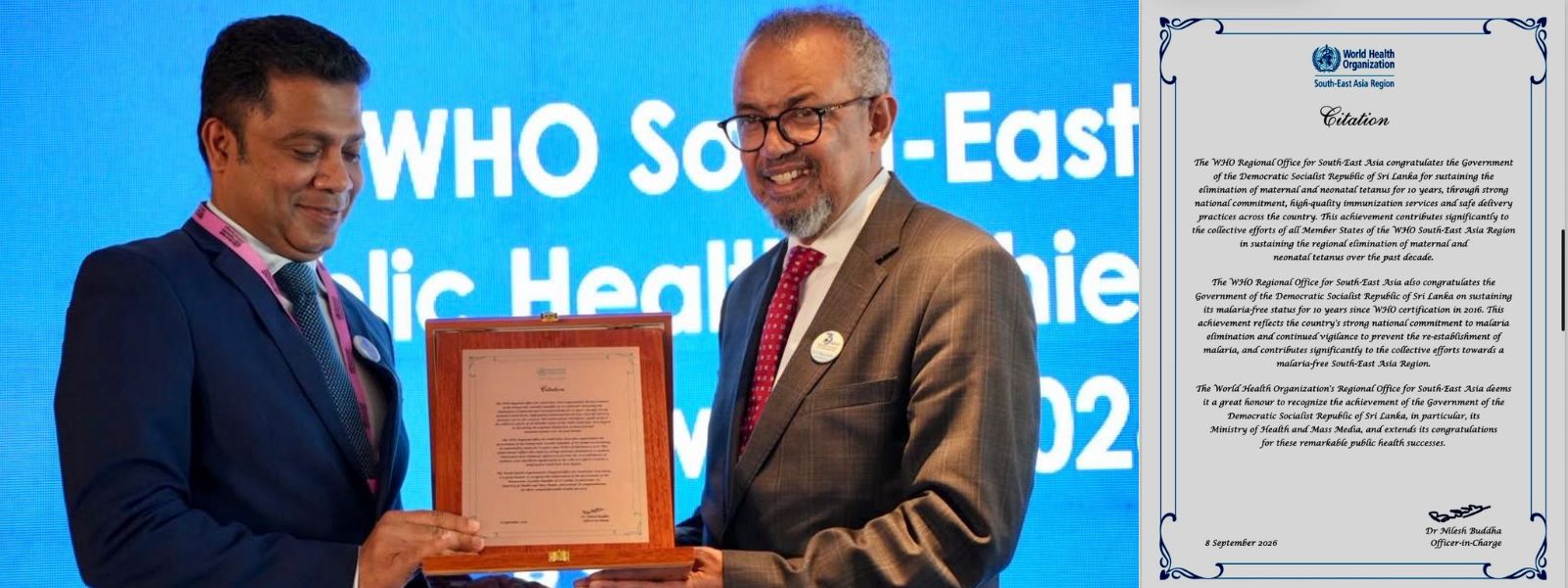
COLOMBO (News 1st); Sri Lanka has received a prestigious World Health Organization (WHO) Citation in recognition of two of the country's most significant and historic public health achievements: sustaining the elimination of maternal and neonatal tetanus and maintaining its malaria-free status continuously for ten years.
The special recognition was presented during the 79th Session of the WHO Regional Committee for South-East Asia in Dili, Timor-Leste.
The citation, signed by Dr. Nilesh Buddha, Officer-in-Charge of the WHO Regional Office for South-East Asia, was presented to Minister of Health and Mass Media Dr. Nalinda Jayatissa by WHO Director-General Dr. Tedros Adhanom Ghebreyesus.
According to the citation, the WHO Regional Office for South-East Asia congratulated the Government of Sri Lanka for sustaining the elimination of maternal and neonatal tetanus for 10 years through strong national commitment, high-quality immunization services and safe delivery practices across the country.
The WHO noted that this achievement has made a significant contribution to the collective efforts of all member states in the South-East Asia Region to sustain the regional elimination of maternal and neonatal tetanus over the past decade.
Sri Lanka was also recognized for maintaining its malaria-free status for 10 years since receiving WHO certification in 2016.
The citation states that this achievement reflects Sri Lanka's strong national commitment to malaria elimination and its continued vigilance in preventing the re-establishment of malaria, while contributing significantly to the regional goal of achieving a malaria-free South-East Asia Region.
Sri Lanka's elimination of malaria remains one of the most remarkable achievements in the country's healthcare history. The World Health Organization officially certified Sri Lanka as a Malaria-Free Country in 2016, making it only the second country in the South-East Asia Region, after the Maldives, to successfully eliminate the disease.
Over the past decade, Sri Lanka has successfully prevented the reintroduction and spread of malaria within its borders, preserving a public health victory that has earned international admiration and recognition.
The country has also successfully maintained the elimination of Maternal and Neonatal Tetanus (MNT) for ten consecutive years. Sri Lanka continues to implement its nationwide Tetanus Toxoid immunization programme for pregnant mothers at a high standard, helping ensure the continued protection of mothers and newborns.
The World Health Organization attributes these achievements to Sri Lanka's strong and resilient primary healthcare system, sustained national commitment, highly successful immunization programmes, and effective disease surveillance and control mechanisms.
In the citation, the WHO Regional Office described it as a "great honour" to recognize the achievements of the Government of the Democratic Socialist Republic of Sri Lanka, particularly the Ministry of Health and Mass Media, and extended its congratulations for these remarkable public health successes.
The latest recognition places Sri Lanka among a select group of nations that have not only eliminated major diseases but have also successfully sustained those achievements over an extended period, reinforcing the country's reputation as a regional leader in public health and preventive healthcare.
Other Articles


-854451_550x300.jpg)

-803333_850x460-854367_850x460-854433_550x300.jpg)
-854427_550x300.jpg)




Featured News




News 1st, MTV Channel (Pvt) Ltd, MBC Networks (Pvt) Ltd, 45/3, Braybrooke Street, Colombo-02.
T.P : +94 114 792 700, Fax : +94 114 792 733
T.P : +94 114 792 700, Fax : +94 114 792 733




 |  | .webp) |
|---|---|---|
 |  |  |
 |  |  |
 |
